

Logitech Z407 vs Klipsch ProMedia 2.1: Which 2.1 System Is Better?
Z407 prioritizes flexible inputs and a wireless dial; ProMedia 2.1 prioritizes higher wired output, a headphone jack, and a larger subwoofer system.
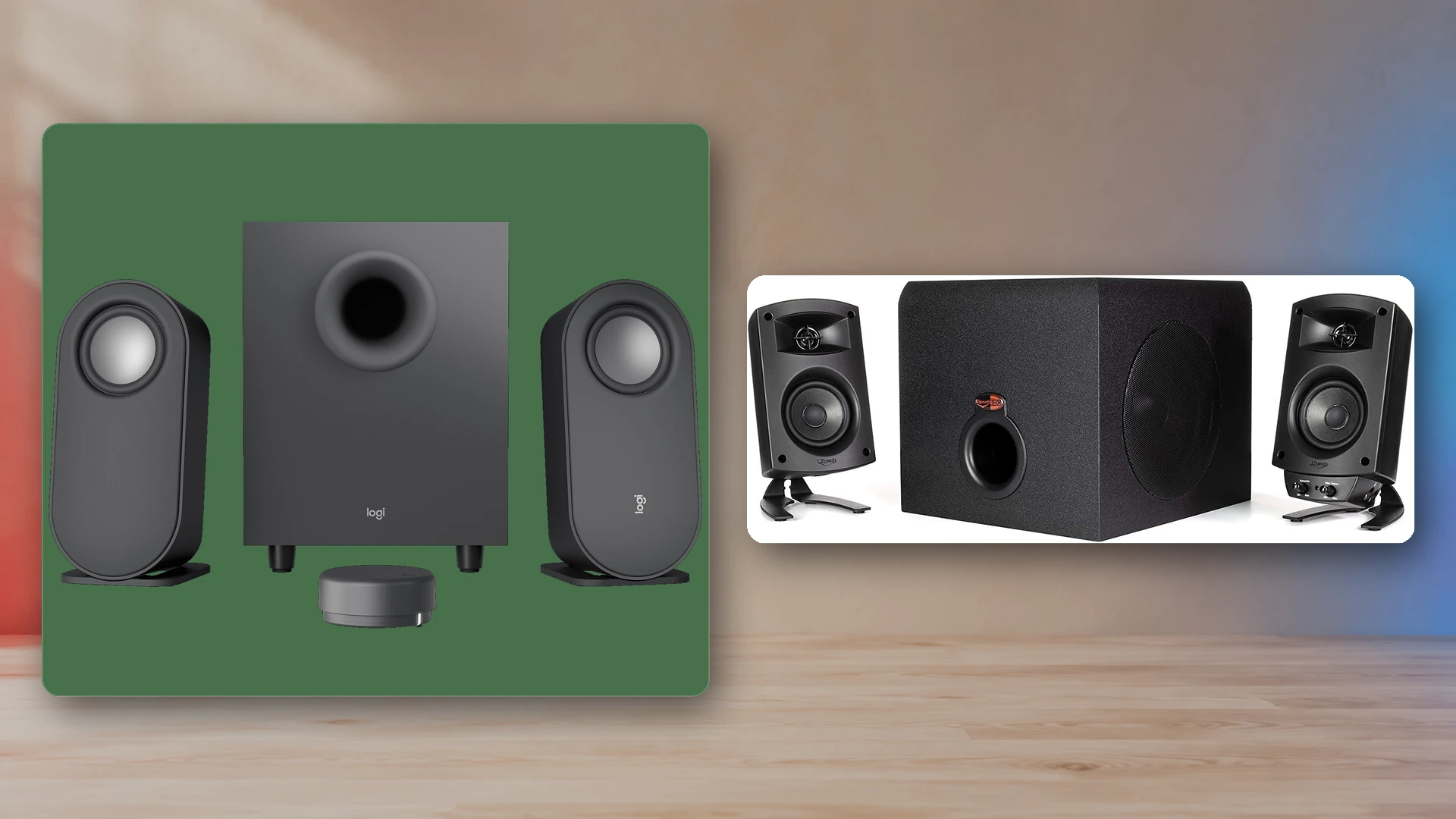
Logitech Z407 and Klipsch ProMedia 2.1 are both three-piece desktop systems, but their priorities are different. Z407 is the flexible modern option with USB audio, Bluetooth 5.0, AUX, compact oval satellites, and a wireless control dial. ProMedia 2.1 THX is the higher-output wired option with a larger subwoofer, 3.5 mm input, headphone output, and direct volume and subwoofer controls on the right speaker.
Logitech Z407 and Klipsch ProMedia 2.1 specifications
| Product | Typical Price | Inputs | Rated Power | Peak Power | Frequency Low | Satellite Width | Satellite Height | Subwoofer Width | Subwoofer Depth | Control Method |
|---|---|---|---|---|---|---|---|---|---|---|
| Logitech Z407 | $129.99 | USB audio; Bluetooth 5.0; 3.5 mm AUX | 40 W | 80 W | 40 Hz | 93.9 mm | 199.9 mm | 234 mm | 180 mm | Wireless control dial |
| Klipsch ProMedia 2.1 THX | $159.99 | 3.5 mm AUX | 100 W | 200 W | 35 Hz | 106.7 mm | 215.9 mm | 249 mm | 259 mm | Right-speaker volume and subwoofer controls |
How the data was assembled
Product selection combines manufacturer specifications, current US pricing, compatibility information, and published measurements. Measurements are attributed to their sources in the comparison data.
Connection flexibility: Logitech wins
Z407 can accept Bluetooth 5.0, micro-USB audio, and 3.5 mm AUX. It can keep several device paths connected and switch among them with the wireless dial. That makes it easier to share among a desktop, laptop, phone, or other compatible source without reaching behind a subwoofer.
The manufacturer lists total RMS output at 40 W.
The manufacturer lists Bluetooth version at Bluetooth 5.0.
The USB data cable is not always included, so budget for the correct cable if USB audio is the planned connection. Bluetooth is useful for convenience, but USB or AUX is the safer choice when predictable latency matters.
Simple wired power: Klipsch wins
ProMedia 2.1 THX is built around a 3.5 mm source and a control section on the right satellite. It does not try to act as a wireless source switcher. Instead, it combines two horn-loaded satellites with a 6.5-inch side-firing subwoofer and a higher continuous output rating.
The manufacturer lists total continuous output at 100 W.
The manufacturer lists listed low-frequency limit at 35 Hz.
The headphone output is useful when speakers must be silenced without changing the computer’s main cable path. The lack of USB, optical, and Bluetooth on the classic THX model is the main limitation.
Controls: wireless dial versus right-speaker knobs
Logitech’s separate wireless dial can sit beside the keyboard and control volume, bass, source selection, playback, and Bluetooth pairing. The dial uses batteries and communicates wirelessly, which keeps the desk clean but adds another device to maintain.
Klipsch places volume and subwoofer controls on the right satellite. The controls are always available and do not need batteries, but the speaker must remain within easy reach. The headphone jack is also on that control side, so the cable route should be considered when placing the pair.
Desk and floor footprint
Z407 satellites are narrow and can stand vertically or lie horizontally. That flexibility helps under a low shelf or beside an ultrawide display. Its subwoofer is shallower than the Klipsch cabinet, although it still needs a clear floor location and room for the down-firing driver and port behavior.
The manufacturer lists satellite width at 93.9 mm.
The manufacturer lists subwoofer depth at 180 mm.
Klipsch satellites are slightly wider and use a taller conventional form. The subwoofer is deeper and heavier, so it needs more floor space and should not be forced into a closed compartment.
The manufacturer lists satellite width at 106.7 mm.
The manufacturer lists subwoofer depth at 259 mm.
Use the speaker-placement guide before choosing based only on output. The better system is the one whose satellites can sit symmetrically and whose subwoofer has a practical location.
Gaming use
Both systems provide real left and right satellites plus a dedicated subwoofer. Z407 is easier to integrate into a mixed-device desk and easier to control without reaching past the monitor. ProMedia 2.1 provides more rated continuous output and a direct wired path, which suits a fixed PC gaming station where high output is useful.
Neither system includes a microphone. Open speakers can also leak into voice chat. A directional USB microphone, lower listening level, or headset may be necessary when party chat is a regular part of play. The format guide covers that decision.
Low-volume and apartment use
A large subwoofer is not automatically better at night. Low-frequency energy can travel through floors and shared walls even when the satellites do not seem loud. Z407’s wireless bass control makes quick adjustment convenient. ProMedia’s subwoofer knob is equally direct but lives on the speaker.
For an apartment, start with the subwoofer lower than expected and place it away from a shared corner. If the room cannot tolerate bass energy, a good 2.0 pair may be the more responsible purchase. See the 2.0 versus 2.1 guide.
Music and movies
Z407 emphasizes convenience: phone playback over Bluetooth, PC audio over USB, and analog fallback through AUX. ProMedia 2.1 emphasizes the scale of a wired three-piece system. Its larger subwoofer and higher power rating can produce more physical impact, but source switching is less convenient.
Neither system should be selected from peak watts alone. Cabinet position, room size, background noise, listening distance, and the way bass interacts with the floor will shape the result. Source-backed specifications describe capability, not a guaranteed response in every room.
Cable planning
- Z407 satellites connect to the subwoofer, and the subwoofer needs AC power.
- USB audio requires a data-capable cable, not a charge-only cable.
- The wireless dial needs a stable desk location and batteries.
- ProMedia satellites and the 3.5 mm source cable converge around the powered system.
- The right Klipsch satellite should remain reachable for controls and headphones.
- Both subwoofers need airflow and should remain out of foot traffic.
Choose the system around connections and space
Z407 is the flexible-input choice; ProMedia 2.1 is the higher-output wired choice. Check current availability before buying.
Final verdict
Return to the best budget speakers pillar for the wider 2.0, 2.1, soundbar, and bookshelf comparison.
Logitech Z407 is the better all-purpose desktop system for most mixed-device setups because USB, Bluetooth, AUX, the wireless dial, and flexible satellite orientation reduce friction. Klipsch ProMedia 2.1 is the better specialist choice for a fixed wired PC station that can use its larger subwoofer and higher continuous output. Neither is automatically right for a small or shared room; measure the floor space and decide how much bass the room can actually support.
Sources

Harry Negron
Harry Negron leads NexusArc's editorial direction across games, player culture, gear, and technology.